CYPERUS PAPYRUS – ALTERNAFOLİUS – UMBRELLA PLANTS

Umbrella Plants (Cyperus) constitute a herbaceous genus comprising approximately 600 species. These plants are sun-tolerant but exhibit low drought resistance. Propagation is achieved via seed or division of basal offsets.
In landscape design, the two most widely utilized species are Papyrus (Cyperus papyrus) and Umbrella Plant (Cyperus alternifolius), which serve as principal visual elements in aquatic gardens. Both species are sensitive to frost and are therefore not suitable for harsh winter climates. In Mediterranean and southern Aegean coastal regions, they can be maintained as perennial specimens. In regions subject to freezing temperatures, they are cultivated as seasonal plants, in winter gardens, or as indoor specimens. In such climates, a practical method involves partially burying the plants in the soil or placing the pots in water from spring to autumn and relocating them to a protected, warm environment during winter.
Both species require consistently moist conditions and tolerate partial submersion of their stems. Consequently, they can be cultivated in shallow water bodies or swampy areas. When grown in containers, the substrate should be kept continuously moist.
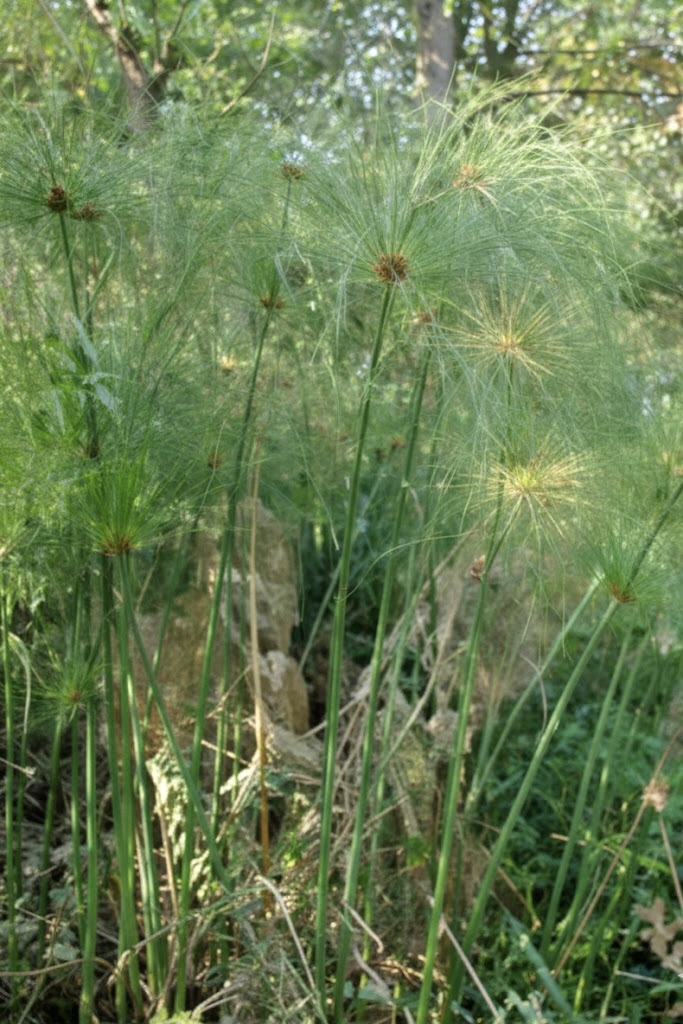
Papyrus (Cyperus papyrus) historically utilized by ancient Egyptians for paper production, is also commonly known as the “Egyptian Paper Reed.” It is a perennial species that propagates via lateral offsets. The stem is long, triangular in cross-section, and pithy, lacking true leaves. From the apex, 100–200 filamentous structures radiate to form a spherical inflorescence head, each filament measuring 12–30 cm in length. Small brown flowers are borne terminally on each filament. As the inflorescences mature and gain weight, the stems exhibit a lateral inclination.
Native to Egypt and tropical Africa, C. papyrus is frost-sensitive and requires greenhouse cultivation in regions prone to freezing. The species attains heights of up to 200 cm, with lateral offsets enabling a single plant to occupy a diameter of 70–130 cm. Optimal growth requires a consistently humid environment. Historically, the Egyptians processed the triangular stems longitudinally with sharp tools, aligned multiple stems side by side on a firm surface, and pounded them to produce thin sheets, which were sun-dried to create paper.
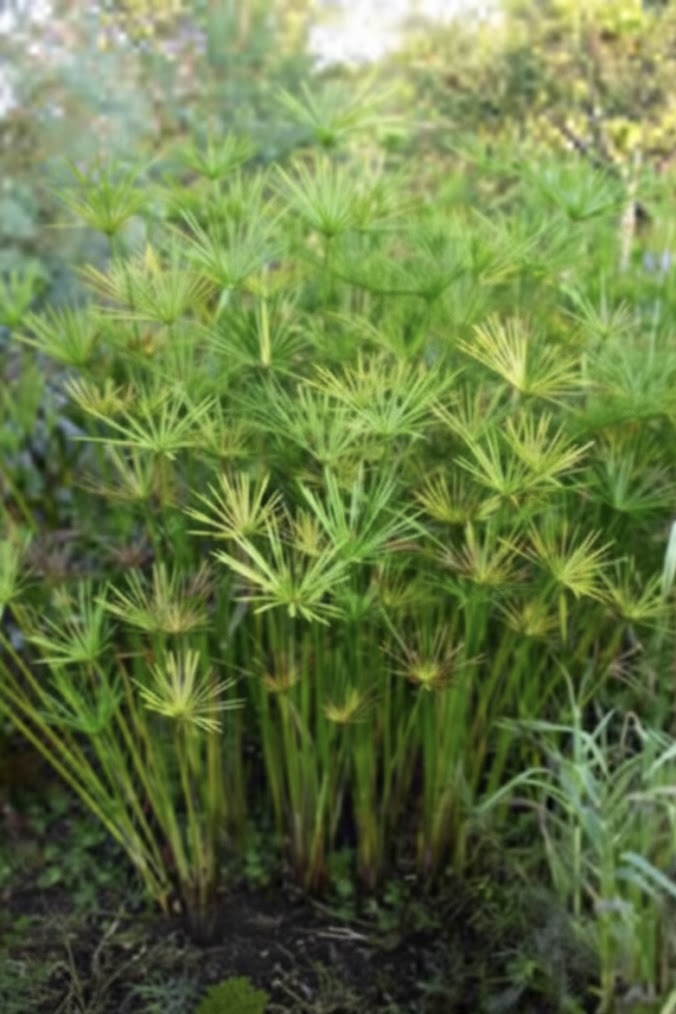
Umbrella Plant (Cyperus alternifolius, syn. Cyperus involutus)
Cyperus alternifolius reaches heights of up to 150 cm and, through basal offsetting, can form clumps spanning 200–250 cm in diameter. The stem is triangular, similar to C. papyrus, and bears radiating leaf-like structures at the apex; these are not true leaves, are broader than those of C. papyrus, and occur in smaller numbers. This species is commonly cultivated as an indoor ornamental in temperate regions due to its aesthetic appeal and adaptability.