
HESPERALOE PARVİFLORA – RED YUCCA
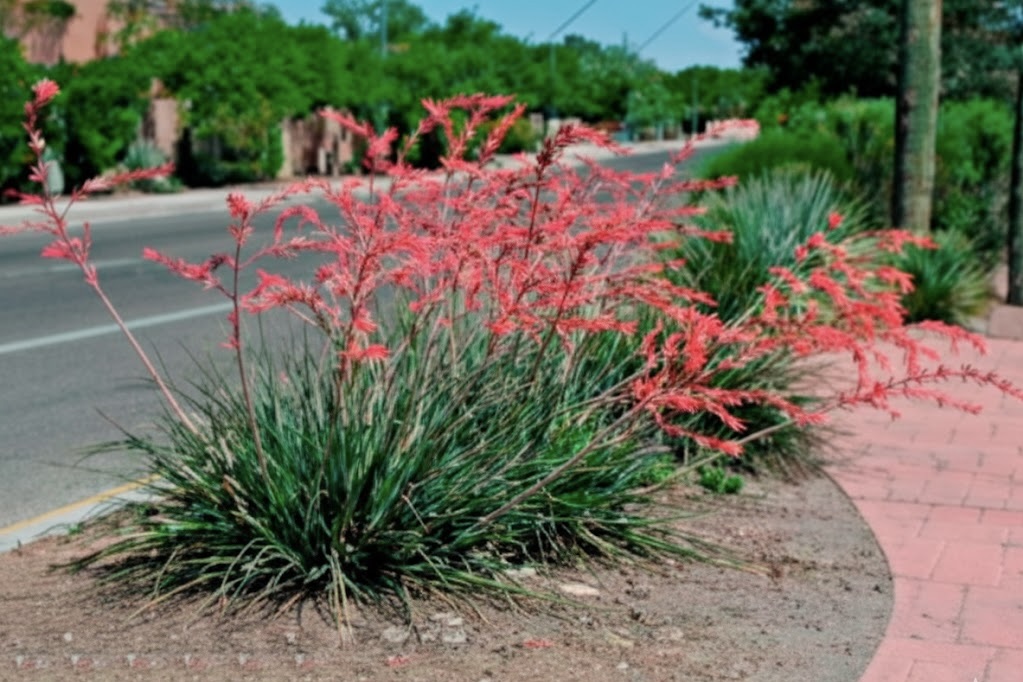
For use in rock gardens, and for sites requiring exceptional tolerance to summer drought and winter frost, Hesperaloe parviflora is highly recommended. This species produces red flowers that persist for several months and provides strong ornamental interest.
Commonly referred to as the cold-hardy red yucca, Hesperaloe parviflora is reported to tolerate temperatures as low as –18 °C. It is widely used in temperate and cold climate regions to create a tropical or xerophytic visual effect. When planted as a solitary specimen, the plant gradually increases in diameter through lateral offsets, forming broad clumps and producing numerous long-stalked red inflorescences. It is also suitable for roadside plantings and group compositions.
In Turkey, Hesperaloe parviflora was first propagated and evaluated at the Palm Centre, where a limited number of plants have recently been made available for sale. Production has since been initiated from seeds obtained from the Centre’s original stock plants, with additional plants expected to be released in coming years.
The genus Hesperaloe belongs to the family Agavaceae and comprises five perennial species. Plants typically reach up to 1 m in height. The generic name is derived from Aloe, combined with the Latin prefix Hesper- meaning “western,” referring to the native distribution of the genus in the southwestern United States and northern Mexico. Despite the name, Hesperaloe is not closely related to African Aloe species but shows a strong affinity to the genus Yucca.
Species of Hesperaloe are stemless and form dense or open rosettes. A diagnostic characteristic of the genus, particularly evident in H. parviflora, is vegetative spread by rhizomes. Plants possess a deeply penetrating, thick taproot and narrow, rigid, channelled leaves with fibrous margins. Leaf margins bear numerous conspicuous, curly fibres that are white to grey in colour. Inflorescences are produced on scapes 120–250 cm in length; flowers are tubular, slightly pendulous, and pinkish-red. The fruit is a capsule.
Hesperaloe parviflora This stemless species reaches 100–140 cm in height and slowly forms clumps 150–200 cm in diameter through basal offsets. Native to northern Mexico and southwestern Texas, this succulent has long, narrow, green leaves. In spring, it produces paniculate inflorescences on scapes 150–200 cm tall, bearing bell-shaped, pink-red flowers 2–3 cm in length. Flowering persists throughout the summer, typically from May to October.
Cultivation: Hesperaloe parviflora is a long-lived, evergreen species adapted to arid climates and requires well-drained, stony soils. Excessive organic matter or heavy clay soils may lead to root and crown rot. Limited and infrequent incorporation of compost or other organic amendments may improve soil structure in clay soils. In poorly drained sites, planting on raised beds, mounds, or berms is recommended. Incorporation of sand, gravel, or crushed brick improves drainage and enhances cultivation success in cool, moist climates. The species is particularly well suited to rock gardens.
Cold tolerance to –18 °C has been documented. Propagation is achieved either by seed or by division of basal offsets. When grown from seed, flowering typically occurs after 2–4 years.

