DİETES – DİETES’S

Dietes are evergreen, long-lived, rhizomatous (tuberous-rooted) plants comprising six species. Their native range includes Central and Southern Africa as well as Lord Howe Island in Australia. In the wild, they are found in dry or wet grasslands and at forest edges.
All Dietes species are stemless, with slender, elongated leaves arising from the base and growing vertically, while older leaves arch outward. New shoots, or “offspring,” develop from the spreading rhizomes. The striking flowers borne on long inflorescences are short-lived and bloom from spring through summer. Generally, Dietes can tolerate temperatures down to -8 to -10°C. In colder regions, cultivation under greenhouse conditions or indoors is recommended.
Due to their attractive, fine, and elegant foliage and showy large, colorful flowers, Dietes are widely used in landscaping, particularly around pools and in wetland gardens. They perform best in well-drained, humus-rich soils with regular watering. Plants should be adequately watered until the end of the flowering period and fertilized monthly with a balanced fertilizer. After flowering, both water and fertilizer should be reduced or withheld. Dietes can grow well in full sun as well as in partial shade.
Propagation is achieved by seeds or division of rhizome offsets. Seeds should be sown in spring or autumn. Division of offsets is recommended after the flowering period. Three of the six Dietes species are produced at the Palm Center. Information on the Dietes cultivated at our center is provided below:
YELLOW DIETES: Dietes bicolor (Syn. Moraea bicolor) – Native to South Africa. Flowers are lemon-yellow and reach up to 90 cm in height. Of the six petals, three are larger and exhibit brown basal “eyes.”
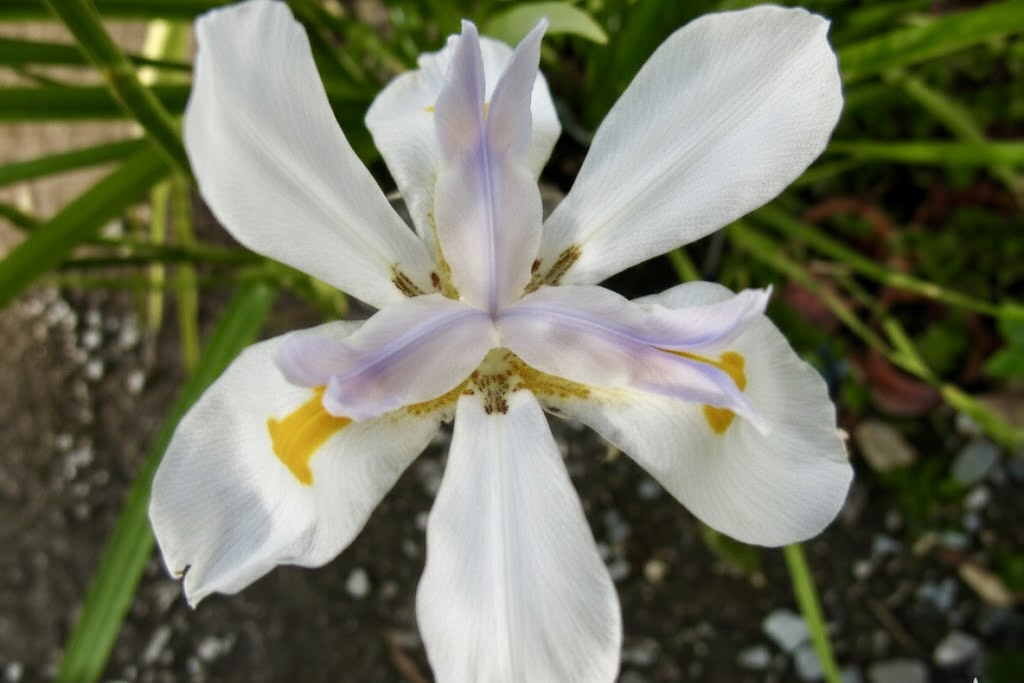
LARGE-FLOWERED DIETES: Dietes grandiflora – This species grows up to 100 cm in height and spreads to 100 cm in diameter through rhizome division. Flowers are 8–10 cm in diameter, iris-like, pale blue, with central markings of purple and orange. Flowering begins in spring and continues throughout summer.
IRIS-FLOWERED DIETES: Dietes iridioides – Shorter than D. grandiflora, reaching up to 60 cm in height. Flowers are 6–8 cm in diameter, and flower stalks can reach 60 cm in length. Being an understory species, it thrives in partial shade beneath tall trees.