MELİANTHUS MAJOR-GREAT HONEY FLOWER
It is among the plant species that we were the first to propagate in our country. Of the six species belonging to the genus Melianthus, native to South Africa, Melianthus major and Melianthus comosus have been propagated at our Center, where their cold hardiness has been studied.
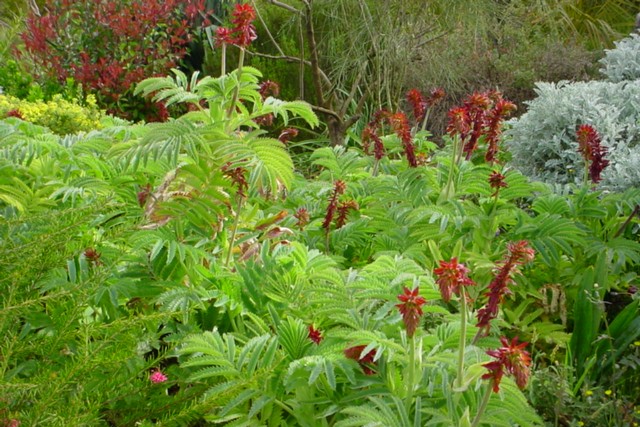
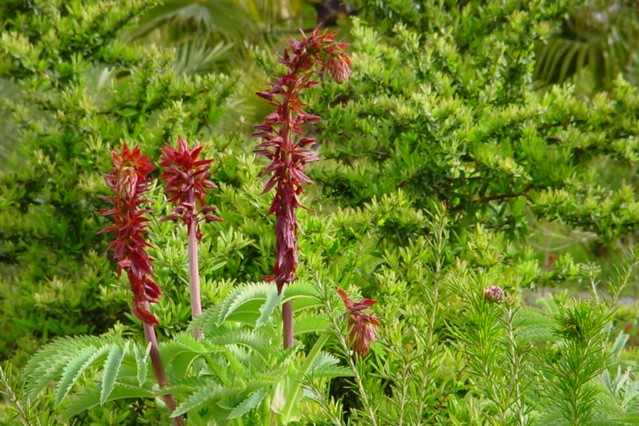
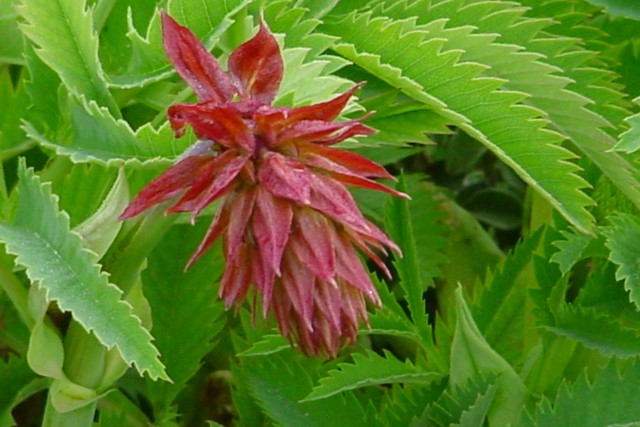
According to the RHS Plant Encyclopedia, the Honey Bush is reported to tolerate temperatures of −(1–2) °C. However, based on our own experience, it has withstood short-term temperatures of −(6–8) °C without even foliar damage. The bluish to pale green leaves, composed of 9–17 segments, deeply toothed and oval in shape, can reach 30–50 cm in length. This unusual and highly distinctive foliage makes Melianthus immediately recognizable among other plant groups. The plant reaches 2–3 meters in height and several meters in width, with branches extending laterally in an irregular manner, gradually increasing the area it occupies. In spring, it produces very distinctive, dark red flowers borne on long stalks. As seen in the photograph, the combination of red flowers and bluish foliage creates a striking visual contrast. The plant can be propagated from seed and, although more difficult, by cuttings.
Melianthus comosus, belonging to the same family as Melianthus major, has also been propagated at our Center and has been found to be equally cold-hardy. Melianthus comosus produced its first flowers in March 2004.
This year, Melianthus major will be offered for sale in very limited quantities; however, we hope to make this plant available at a more affordable price in the coming year. Propagation efforts for Melianthus comosus are ongoing.