PLUMERİA FRAGNGİPANİ-PLUMERİA
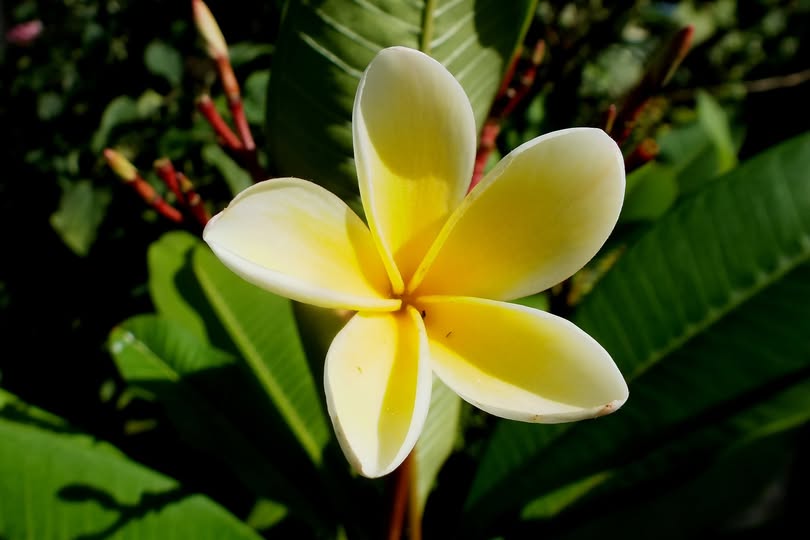
Plumerias, regarded as some of the trees bearing the most beautiful flowers in the world, belong to the Apocynaceae family and comprise eight species. They are deciduous or semi-evergreen shrubs or small trees.
They possess succulent trunks and thick, fleshy branches, and are native to tropical and subtropical regions of the Americas. In Asia, particularly among Buddhist communities in India, temples are traditionally adorned with the showy, intensely fragrant flowers of this plant; for this reason, it is also known as the Indian Temple Tree. Outside their native range, Plumerias are widely used for ornamental and landscape purposes in many tropical and subtropical countries. Plumerias are frost-sensitive and are propagated by seed or cuttings.
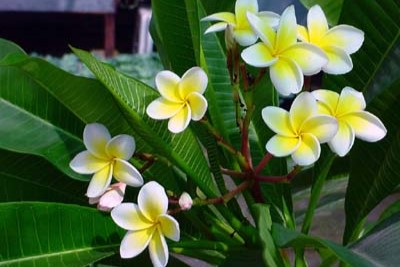
Plumeria alba is native to the Lesser Antilles and Puerto Rico and is therefore commonly referred to as the West Indian Jasmine. It may be described as a large shrub or a short, broad-canopied tree. Its dark green leaves, borne on stout branches, reach 25–30 cm in length and are slightly pubescent on the underside. The tree can attain a height of up to 6 meters and a spread of approximately 4 meters. Its showy, cluster-forming, white flowers with a yellow center are highly fragrant and bloom throughout summer and autumn.
This species, with established trees in Rhodes, Cyprus, and Alanya, can be cultivated along the Mediterranean coastal belt in sheltered locations or under greenhouse conditions. At the Palm Center greenhouses, magnificent specimens reaching heights of up to 300 cm are available for sale.
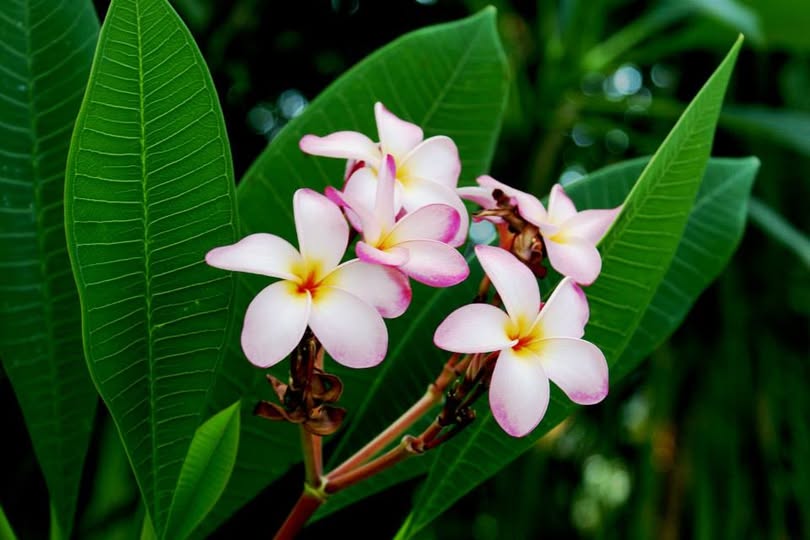
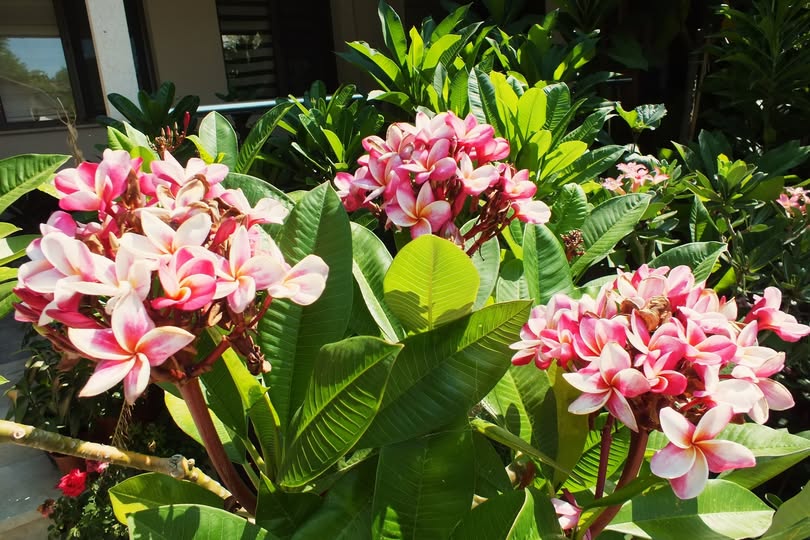
Plumeria rubra is native to Mexico and Panama and closely resembles the species described above. Trees of this species can grow slightly larger than Plumeria alba. The flowers, which also have a yellow center, are typically rose-pink but may occasionally be yellow, red, or bronze in color. Specimens reaching 150–200 cm in height are available for sale in the Palm Center greenhouses.