
VERBENA BONANSİS-PURPULE TOP
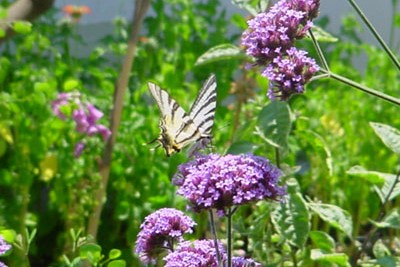
Verbena bonariensis, a member of the Verbenaceae family, is native to the South American continent. It occurs naturally in wetland areas of southern Brazil, Argentina, Uruguay, and Paraguay. Its slender, round stems—often several per plant—reach heights of 100–150 cm. The leaves are narrow, sparse, and borne close to the stem. At the tips of long flower stalks, small purple flowers are clustered together in dense, honeycomb-like inflorescences.
Although little known in our country, this species is frequently featured in international landscape design literature. It was first propagated at our Center in 2003 and showed no damage at temperatures as low as −6 °C. According to published sources, it likely tolerates temperatures down to −10 °C or possibly lower. Even if the plant is killed by frost, numerous seedlings emerge the following year from self-sown seeds. In landscape design, it can be used to create soft transitions and color harmony or contrast between low-growing plants and larger shrub or tree groupings.
One of its most notable characteristics observed by us is its strong attractiveness to butterflies; for this reason, we have named it the “Butterfly Verbena.” This brief introduction presents a plant that allows us to admire the familiar purple verbena at eye level, rather than having to look down at it as with ground-cover forms.


