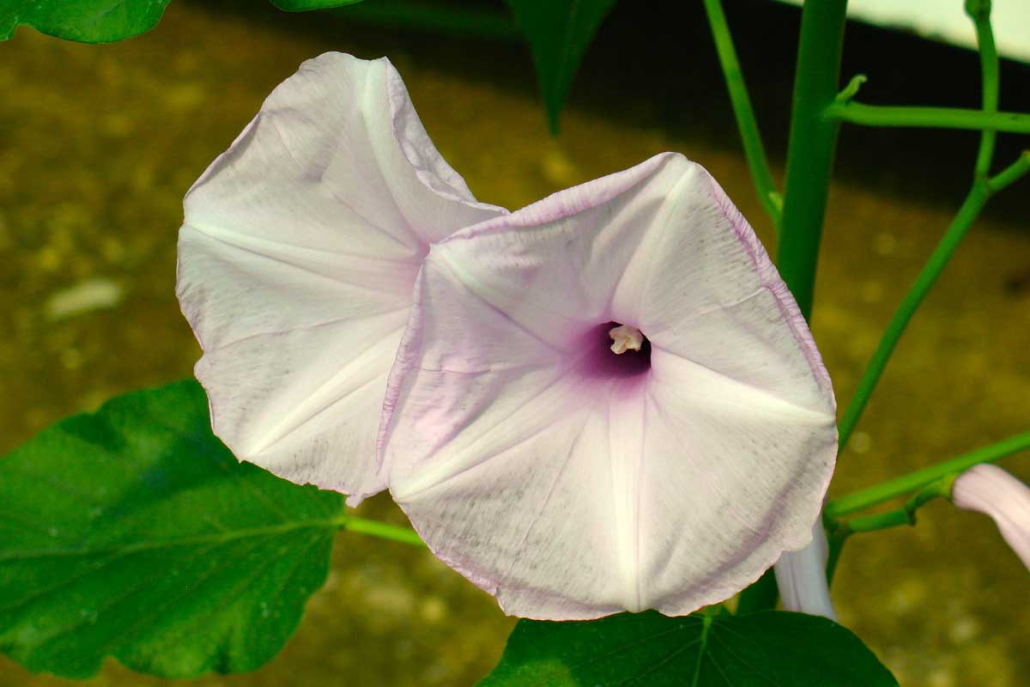
IPOMOEA CARNEA SPP. FISTULOSA – BUSH MORNING-GLORY

Ipomoea is one of the 58 genera in the Convolvulaceae (Morning Glories) family. Ipomea genus, covers about 1800 species that are perennials and annuals which found in North and South America, West Indies, Hawaii, Asia, and South Africa. The popular, Ipomoea batatas (Sweet Potato) and Ipomoea x multifida, (Cardinal Climber: a hybrid between Ipomea quamoclit and Ipomea coccinea) are common garden plants in many countries. Genus’s name, Ipomoea, comes from the Greek words ips and homoios, that mean ‘worm-like’, is a reference to the plant’s vine-like growth. The species epithet carnea means ‘flesh-coloured’ in Latin, which refers to the pale, flesh pink flowers of the plant.
Ipomoea carnea spp. fistulosa, is a species of morning glory that grows as a bush. Naturally found in the tropical and subtropical New World, from Argentina to Mexico. Today it is naturalized in many tropical regions of the world. The specific name, fistulosa, comes from Latin, means hollow or ‘reed-like’, referring to the hollow stems of the plant.
Bush Morning-Glory is a partially deciduous, perennial shrub, mostly dormant during winter but start growing during warm season and can reach 3-5 meters tall in a season if left unpruned. It makes multiple basal stems and a massive tuber. Plant has green, cordate to deltoid, large leaves 10–15 cm long with distinct petiole and prominent mid-vein. Blooming start in spring to end of the autumn. Flowers are in clusters at the ends of branches; corolla pink to mauve and 5-8 cm long. There is one variety with white flowers. Fruit is a capsule, brown, seeds are covered with hairs.
Ipomoea carnea spp. fistulosa, prefer full sun or semi shade, well-draining soil, it is not particular about soil, surprisingly tolerant of alkaline soils. Plant is not frost resistant but can resist -4ºC cold for a short time. Propagation may be done easily by seed or by cuttings.
Medical studies, indicate that pollen of Bush Morning-Glory contain allergenic proteins. Seeds of the plant are toxic and it can be hazardous to cattle; the toxicity is related to the swainsonine, and to bioaccumulation of selenium in the leaves but mostly in the seeds. In Mozambique, it was reported that about 10% of goats died within 12 months of exposure to the plant available in most parts of the year. Ingestion of seeds or leaves causes abnormal endocrine and gastrointestinal functions, immune system alternation, abnormality in embryogenesis. Ipomoea carnea spp. fistulosa is also of medicinal value, contains a component identical to marsilin, a sedative and anticonvulsant. A glycosidic saponin has also been purified from this plant with anticarcinogenic and oxytocic properties.
The stem of Bush Morning-Glory can be used for making paper. In Brazil, is known as “pipe-cane”, as its hollow stems were used to make tubes for tobacco pipes. In tropic and subtropic areas may escapes from cultivation and become established in disturbed areas such as roadsides, riverbanks and other moist areas as an invasive plant.
Landscape Use: Ipomoea carnea spp. fistulosa, is cultivated as an ornamental or in hedges and windbreaks. It can be used as a flowering accent shrub for tropical and subtropical garden colour in “old fashioned” tropical desert gardens. It is a good choice for trellis as floriferous, tropical-looking plant. It can be a nice pot plant by occasional pruning