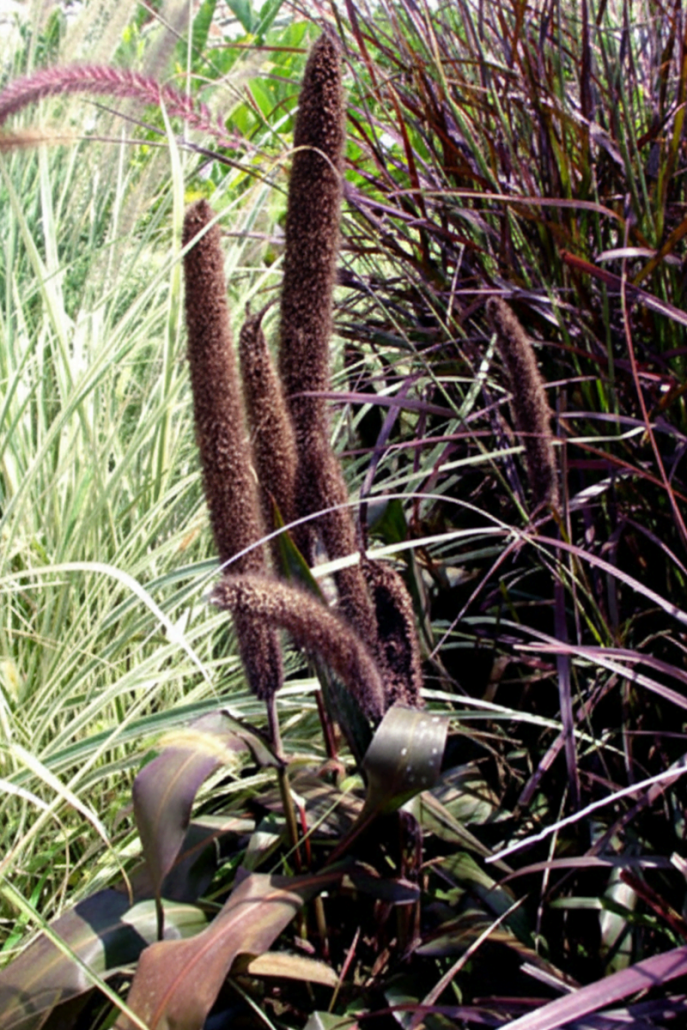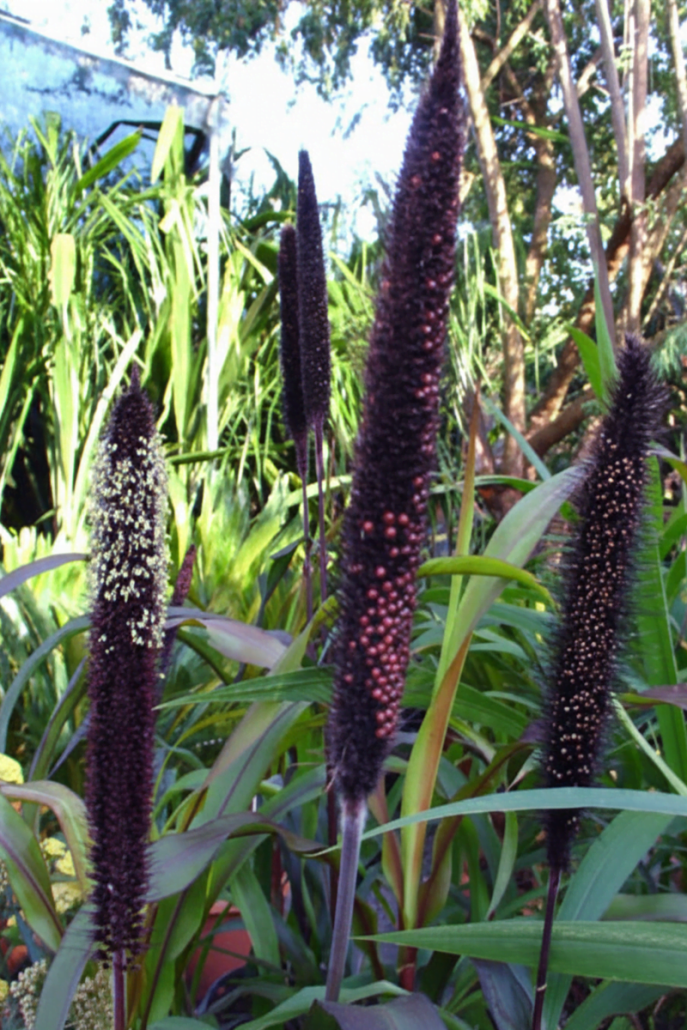
PENNISETUM GLAUCUM PURPLE MAJESTY – ORNAMENTAL MILLET / CAT TAIL MILLET
Did you know that many of us have never heard of Pearl Millet, yet it is the main staple for 90 million people in tropical regions of Africa (especially West Africa, south of the Sahara) and India?
This cereal, cultivated for over 5,000 years in Africa along the west of the Nile and south of the Sahara, was later introduced from Africa to Asia.
Pearl Millet thrives in hot climates with low and irregular rainfall and poor soil quality, producing higher yields than maize under these conditions. While the grains are consumed by humans, its stalks are also used for animal feed, fuel, and building simple shelters.
The Pennisetum genus contains around 140 tropical herbaceous species. Many Pearl Millet species are resistant to soil pests called nematodes. Nematodes that colonize the roots of these plants lose their reproductive capacity, reducing their populations. Pearl Millet species also improve the soil’s carbon-to-nitrogen ratio and are often used as green manure.
ORNAMENTAL MILLET / CAT TAIL MILLET – Pennisetum glaucum Purple Majesty
Today we introduce Ornamental Millet, an F1 hybrid derived from Pearl Millet species. This annual plant is easy to grow, featuring striking dark red foliage and small, corn-like seeds on almost black stems, making it both interesting and attractive. Seeds from one season can be easily propagated for the next.
Propagation is done via seeds, which generally germinate in less than 10 days at 20–25°C. Seedlings are initially green and start turning pink after eight weeks. Once planted in sunny garden locations, the foliage develops its rich dark red color. While not particularly fussy, the plant performs best in well-drained soil under full sun. Plants moved from indoors should be gradually acclimated to sunlight: first in partial sun, then full sun. Plant spacing should be 15–20 cm.
In landscaping, Ornamental Millet is often used as a border plant to add height and color. It is also cultivated in sunlit verandas, terraces, inner and side courtyards, and containers to create a tropical effect.