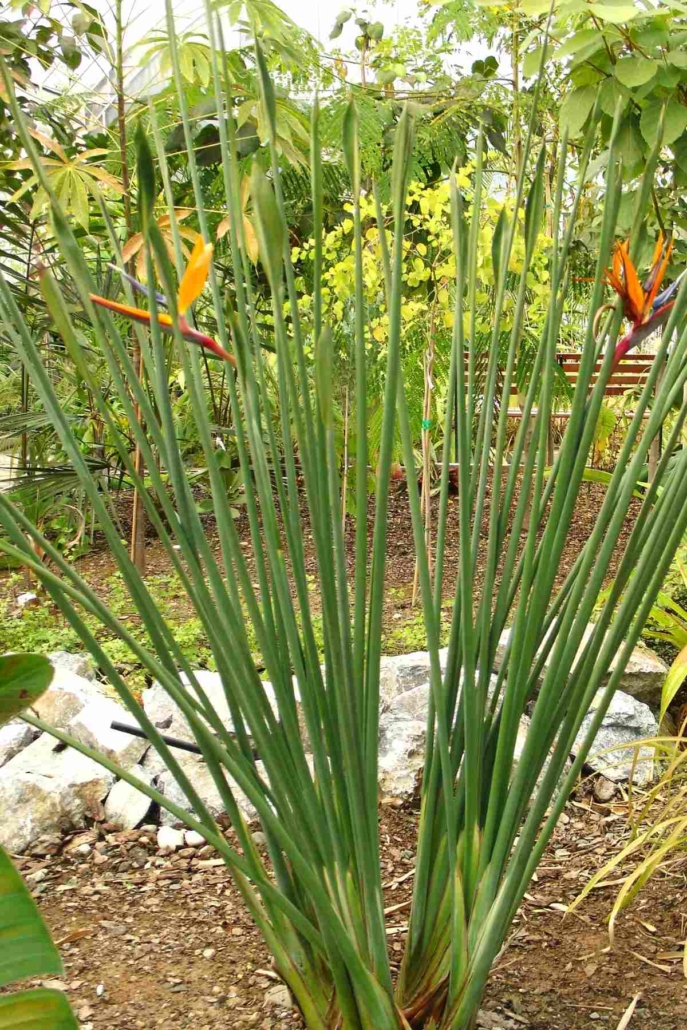
STRELITZIA JUNCEA- AFRICAN DESERT BANANA NARROW-LEAVED BIRD OF PARADISE- CRANE FLOWER

The Strelitziaceae family have three genera with seven species which very similar in appearance and growth habit to members of the Heliconiaceae and Musaceae (banana) families. The APG II system assigns the Strelitziaceae to the order Zingiberales in the commelinid clade. rush-leaved strelitzia
The Strelitziaceae covers three genera, all occurring in tropical to subtropical regions: Ravenala (Ravanala madagascariensis-Travelers Palm) with a single species in Madagascar, Phenakospermum (Phenakospermum guyanensis-Small Travelers Palm) with a single species in northern South America and Strelitzia with five species in southern Africa.
Species of the Strelitzia: Strelitzia reginae (Bird of Paradise), Strelitzia alba (White Bird of Paradise), Strelitzia caudata (Mountain strelitzia), Strelitzia nicolai (White or Giant Bird of Paradise), Strelitzia juncea (Narrow-leaved Bird of Paradise).
Strelitzia juncea is a monocotyledonous flowering plant that is indigenous to South Africa. In the past Strelitzia juncea was regarded as a variety of Strelitzia reginae, but today is excepted as a different species. This drought-resistant plant naturally found sparingly near Uitenhage, Patensie and just north of Port Elizabeth of South Africa. It is the only Strelitzia species which typically lacks a leaf blade. It also differs from Strelitzia reginae in having an inflorescence that is shorter than the leaves, while those of Strelitzia reginae’s are taller. Species name Strelitzia comes from the wife of George III of England; Queen S. Charlotte who was a princess of Mecklenburg-Strelitz. The specific name juncea is derived from the Latin juncus meaning rush a reference to its rush-like appearance
Narrow-Leaved Bird of Paradise
is a perennial herb up to 200 cm high, producing thick fleshy roots and upright cylindrical leaves without a leaf blade. Plant produces large orange flowers borne on long, cylindrical stalks from October to April. Although the leaves are very different, flowers resemble those of the more commonly cultivated Strelitzia reginae. The inflorescence consists of a boat-shaped spathe bearing five flowers on average. Spathe of the flowers is 150 mm long, green with red edges, sepals lanceolate in shape, bright orange, petals are blue in colour.
Strelitzia juncea requires full sun, or partial shade, well-drained, rich soil. Plant can survive on very little water. The species is slow growing and takes 3-4 years to flower. Grown under ideal conditions plant is floriferous and long-lived. In its natural habitat, plant is pollinated mainly by sunbirds. It is interesting as that as seedlings, these plants are identical to normal Strelitzia reginae, complete with the typical boat-shaped leaves. As they mature the leaf blades become shorter and more paddle-like, eventually shrinking to little ‘spoons’ and finally disappearing completely. They are intermediate forms (hibrids) exist between Strelitzia reginae and Strelitzia juncea. Propagation is done by seed and division of the fans. Plant withstands -4 ºC cold for a short time, although some says it is more resistant to cold than Strelitzia reginae.
Use in Landscape: Strelitzia juncea, a striking accent or feature plant with interesting leaves and shape, in open ground or in a container. As a garden subject it is an ideal accent plant or planted to form a bold group which requires little attention. As it is quite drought-tolerant plant suits xeric landscape. The long-lasting flowers and leaves are used for flower arranging.