
VITEX AGNUS-CASTUS – CHASTETREE – VITEX – LILAC CHASTETREE
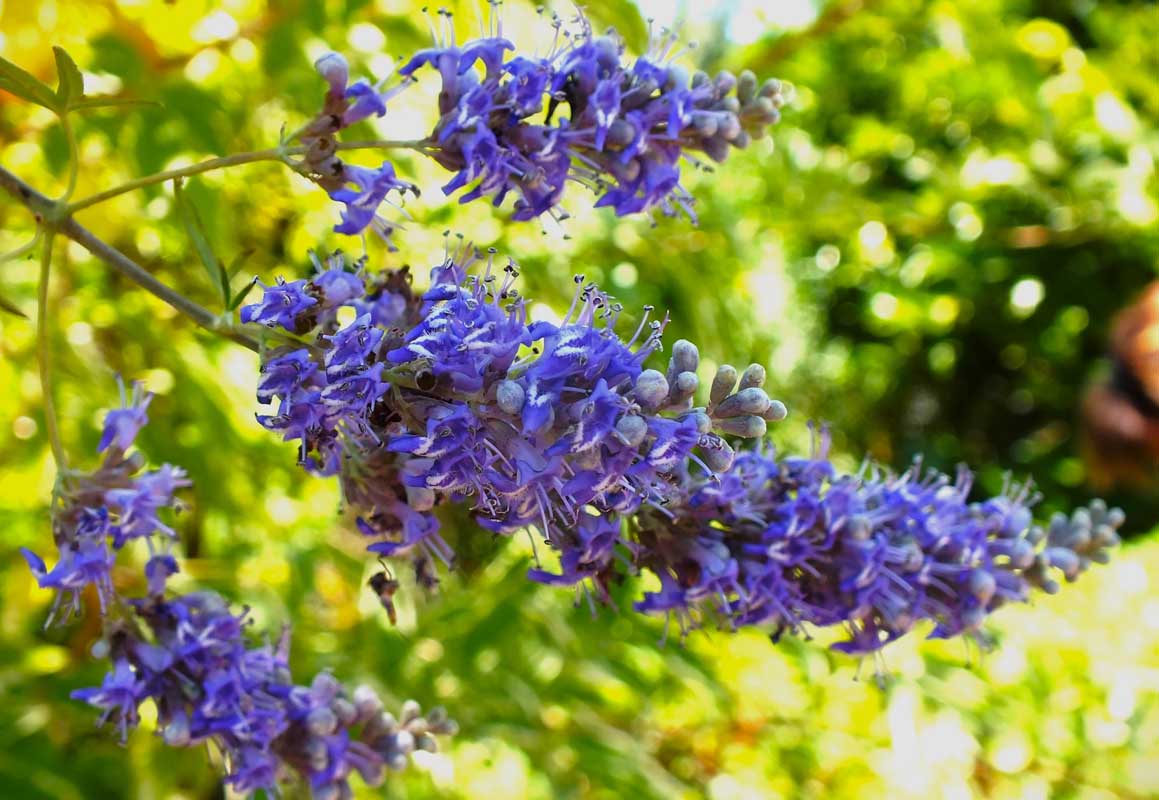
Vitex agnus-castus is an aromatic, deciduous shrub, belongs to Lamiaceae (formerly Verbenaceae) “Mint” family. It is also called Lilac Chastetree, Chaste Berry, Monk’s Pepper Tree or Wild Lavender. It is one of the few temperate-zone species of vitex, which most of the members of the genus of tropical or subtropical flowering plants. Theophrastus mentioned the shrub named agnos in “Enquiry into Plants”. Vitex, is derived from the Latin vieo by Pliny, meaning to weave or to tie up, a reference to the use of Vitex agnus-castus in basketry. In ancient times, it was believed to be an anaphrodisiac, hence the name Chastetree. Pliny, in his Historia Naturalis, reported the use of stems and leaves of this plant by women as bedding “to cool the heat of lust” during the time of the Thesmophoria (an ancient Greek 3 days religious festival for woman, held in honour of the goddess Demeter and her daughter Persephone), when Athenian women left their husbands to remain ritually chaste.
Vitex agnus-castus is native to Mediterranean and west Asia (Tunisia, Algeria, Libya, Morocco, Egypt, Baleares, Spain, France, Italy, Slovenia, Croatia, Albania, Greece, Bulgaria, Turkiye, Cyprus, Syria, Lebanon, Iran, Iraq, North Caucasus, Pakistan, Afghanistan, Tajikistan, Turkmenistan). Today introduced into many countries in America continent. production
Chastetree a deciduous, large shrub or small tree typically to 3 to 5 meters tall but known to get to 8 meters in warm locations. It has broad growth and attractive aromatic foliage. Palmate, greyish-green leaves with 5-7 lance-shaped leaflets. The leaves are divided into 7 narrow leaflets, dark green above and gray below. 12 to 20 cm tall spikes of lavender-blue flowers in spring through summer are followed by 2-3 mm round fruit. Often reblooms in autumn. Violet-blue or white spikes of flowers are attractive to butterflies and bees. The tree is often planted where honey is marketed to promote excellent honey.
Vitex agnus-castus requires full sun, though tolerates partial shade, along with well-drained soil, grows well on loamy, neutral to alkaline soil. It is tolerant to salty and dry environment. Cold and wet weather results in dieback and losses. Vitex is a cross-pollinating plant, but its self-pollination has been recorded. Propagation is done by seeds or cuttings; seeds do not need pretreatment. Pruning back the branches in autumn has a positive influence on fruit yield. Because flowering appears on new growth while repruning in spring can induce an increase of vegetative shoots, thus a fruit yield loss. It is hardy to −20 °C. In colder zones, the plant tends to die back to the ground, but as it flowers on new wood, flowering is not affected on vigorous growth in the following season. Chastetree is typically grown in warm winter climates as a deciduous shrub or trained as a single trunk tree up to 5 meters. In cold winter areas, it is more often grown as a 100-150 cm tall like a herbaceous perennial.
Landscape Uses: Vitex agnus-castus is used as a specimen plant that has long been regarded as a symbol of chastity. It is suitable to be used as a small patio or border tree. If it is used as a street or median tree, it will not grow up into powerlines, but branches tend to droop toward the ground and would hinder traffic visibility if planted too close to the street. Median planting would be fine if there is adequate space. Also, it can be grown as a container tree.
Chastetree contains iridoids, flavonoids, progestins, and essential oils. This combination may help control menstrual cycles and ease menstrual pain. The leaves and tender stem growth of the upper 10 cm, along with the flowers and ripening seeds, are harvested for alternative medicinal purposes. Vitex agnus-castus has been used to treat menstrual cycle problems and pain, premenstrual syndrome, and menopause. The berries are believed to be a tonic herb for both the male and female reproductive systems. The seeds and fruits are anaphrodisiac, it may help lower the sex drive in people who wish to stay chaste. It is claimed to help treat painful breasts (mastodynia).


