
ZANTEDESCHİA AETHİOPİCA –
ARUM LILY – CALLA LILY
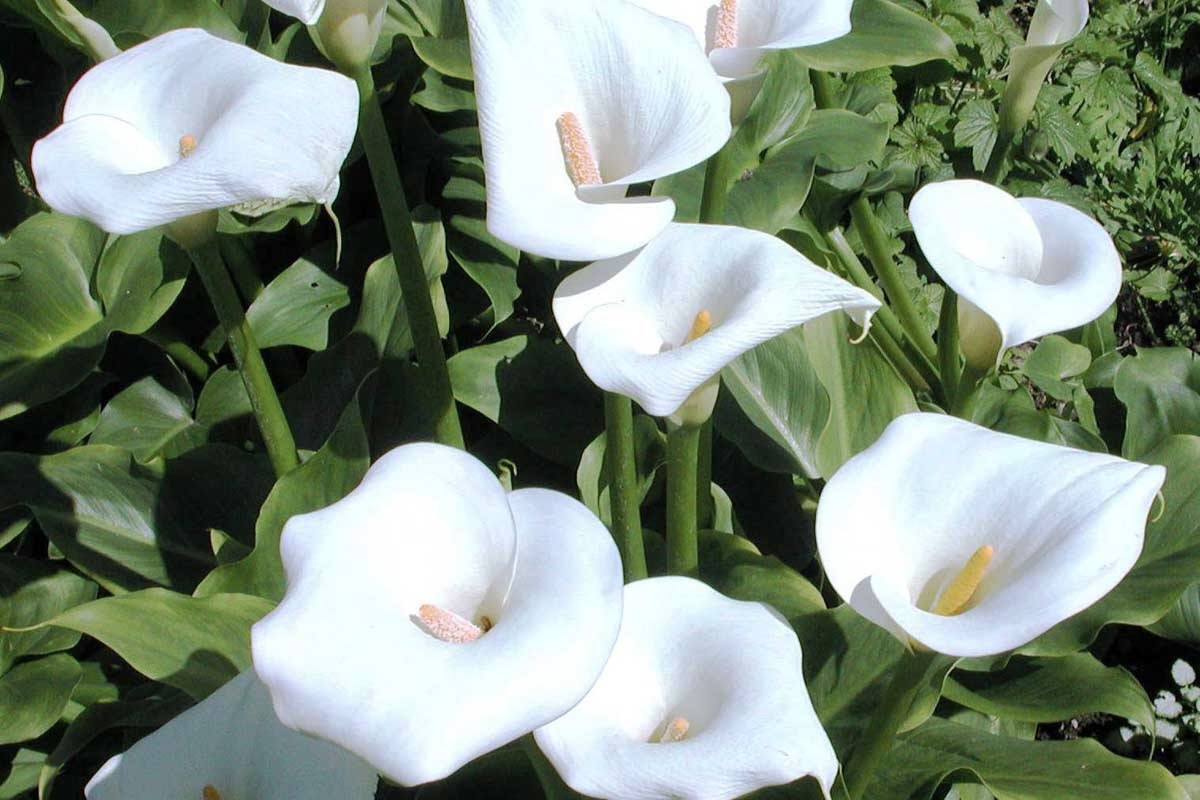
The genus Zantedeschia is restricted to the African continent consist of seven species. Zantedeschia fall into two main types: hardier outdoor forms, often called Arum lilies, with striking white flowers; and the more tender forms, typically with white-spotted leaves and pretty flowers in yellow, orange, pink or dark purple. These are often called Calla lilies.
Zantedeschia aethiopica is native to Southern Africa where it grows in marshy places. It is evergreen or deciduous depending on the habitat and rainfall regime. In the Western Cape it is dormant in summer and in the summer rainfall areas it is dormant in winter. It will remain evergreen in both areas if growing in marshy conditions which remain wet all year around.
Zantedeschia is named after Italian physician and botanist Professor Giovanni Zantedeschi. The species epithet ”aethiopica”refers to the fact that it is native to Africa. Although commonly known as the arum lily or calla lily, it is not a lily but an aroid.
The Arum Lily is well known for its striking appearance when in flower, with a brilliant white floral bract wrapping around a yellow finger-like projection in the centre. The flowering parts arise from a ring of glossy green leaves. The fruits are green berries turn orange at the base when ripe. The flowers of Zantedeschia aethiopica are faintly scented and this attracts various crawling insects and bees which help for pollinating the flowers.
Arum Lily is very popular as cut flowers and as an ornamental. It is used as a symbol of purity in bridal and funeral flower arrangements. The leaves and rhizomes of Arum Lily are traditionally used in dressings and oral preparations for a variety of complaints in southern Africa. The rhizomes are edible, although the plant is reportedly toxic. Traditionally the plant is boiled and eaten. Raw plant material causes swelling of the throat because of microscopic, sharp calcium oxalate crystals. The leaves are also traditionally used as a poultice and a treatment for headaches. Scientists have shown that Zantedeschia aethiopica may be useful in artificial wetland systems to clean waste water and prevent algal growth.
Arum Lily grows best in moist soil or shallow water. Planting under shade is preferable if there is no boggy position for this plant, but this will reduce the number of flowers. Fertile soil is required. In optimum conditions, a good display of flowers may be enjoyed in the spring and summer.
Zantedeschia aethiopica grows to 90 cm but may get taller in the shade. It has dark green leaves with an arrow head shape. The size varies according to the amount of shade. The flowers appear in a main flush from February to June, although there may be the odd flower at other times of the year. Arum Lily forms large colonies in marshy areas ranging from the coast to an altitude of 2250m. Thus one will find them contending with humid, salt laden air at the coast and freezing, misty mountain grasslands at high altitudes. The leaves of the arum are very interesting in that they contain water stomata which can discharge excess water, by a process known as “guttation”. This prevents water-logging and enables arum lilies to grow in wet conditions.
Zantedeschia aethiopica is easily cultivated by seed or division. Seed should be sown in spring. The fleshy rootstock can be divided when the plant is dormant, it should be re-planted not less then 3 cm deep. It may also be propagated by division where the plant is not dormant.
‘Black gammock’) in marshy areas. It can be planted as a foliage plant in deep shade under trees but will not flower well in this position. Nowadays many cultivars of Zantedeschia are available and can be used as pot plants or at garden design.


